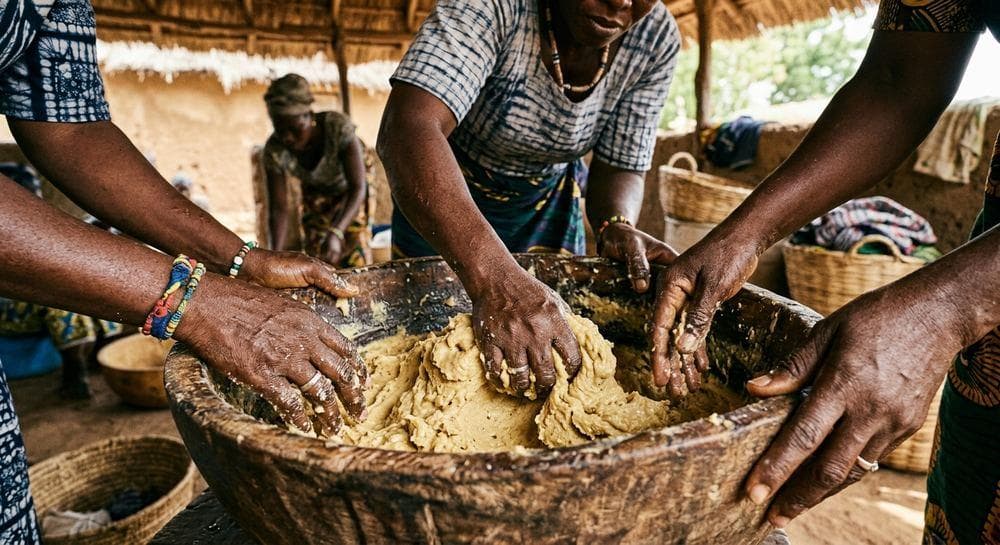
A shea tree takes about fifteen years to bear fruit and can keep producing for two centuries. What happens between that first harvest and the jar on your shelf is almost entirely handwork, and almost entirely done by women.
The tree itself
The shea tree, Vitellaria paradoxa, grows wild across a band of savannah that stretches from Senegal to Uganda. Nigeria sits in the middle of it. Nobody plants shea at scale the way you would plant maize, because the tree takes too long to mature to make that commercially attractive. The trees that produce today were, for the most part, standing before anyone alive today was born.
That single fact shapes everything about the industry. You cannot increase supply by planting more this season. You can only harvest what is already there, more carefully.
Harvest
Fruit falls between roughly May and August. It is collected off the ground rather than picked from the branch, which means harvesting is a matter of walking, bending and carrying, often several kilometres a day. The fruit pulp is edible and often eaten fresh. The nut inside is what becomes butter.
Collection is done overwhelmingly by women, and in many communities the right to collect from particular stands of trees is understood and respected without ever being written down.
Drying and sorting
Once the pulp is removed, nuts are boiled or steamed to stop them germinating, then spread out to dry in the sun. This is the stage most likely to ruin a batch. Nuts that are dried too slowly, or that get rained on halfway through, develop mould and high free fatty acid content. You can taste and smell the difference in the finished butter.
Sorting is done by hand afterward. Anything cracked, discoloured or under ripe is pulled out. It is slow, unglamorous work and it is the single biggest determinant of whether the end product is Grade A.
Roasting and grinding
Dried kernels are roasted, then crushed and ground into a thick, dark paste. Traditionally this is done on a stone grinder, which is punishingly physical work. The roast is a judgement call: under roast and the yield drops, over roast and the butter takes on a burnt note that never leaves it.
Whipping
The paste is mixed with water and worked by hand, often by several people around one bowl, until the oil separates out as a pale curd. That curd is washed, then gently heated and left to settle. What rises is shea butter. What is left behind is the residue.
The butter is then whipped as it cools, which is what gives good shea its soft, aerated texture rather than a hard waxy block.
Why the method matters
Industrial extraction uses hexane, a solvent, to pull more oil out of the same quantity of nuts. It is more efficient and it is how a great deal of the world's shea is produced. It also strips out much of what makes shea worth using in the first place, which is why solvent extracted shea is almost always then refined, bleached and deodorised into a neutral white fat.
Unrefined shea keeps its ivory colour, its nutty smell and its vitamin content, because none of those things were processed out. That is the whole argument for doing it the slow way.
- Colour tells you it was not bleached
- Smell tells you it was not deodorised
- Texture tells you it was whipped rather than poured and set
If a shea butter is pure white and smells of nothing, it has been through a great deal to get that way.
Want to see it rather than read it? The seed to jar sequence on our story page runs through every stage above.